Tripoli | March 26, 2026
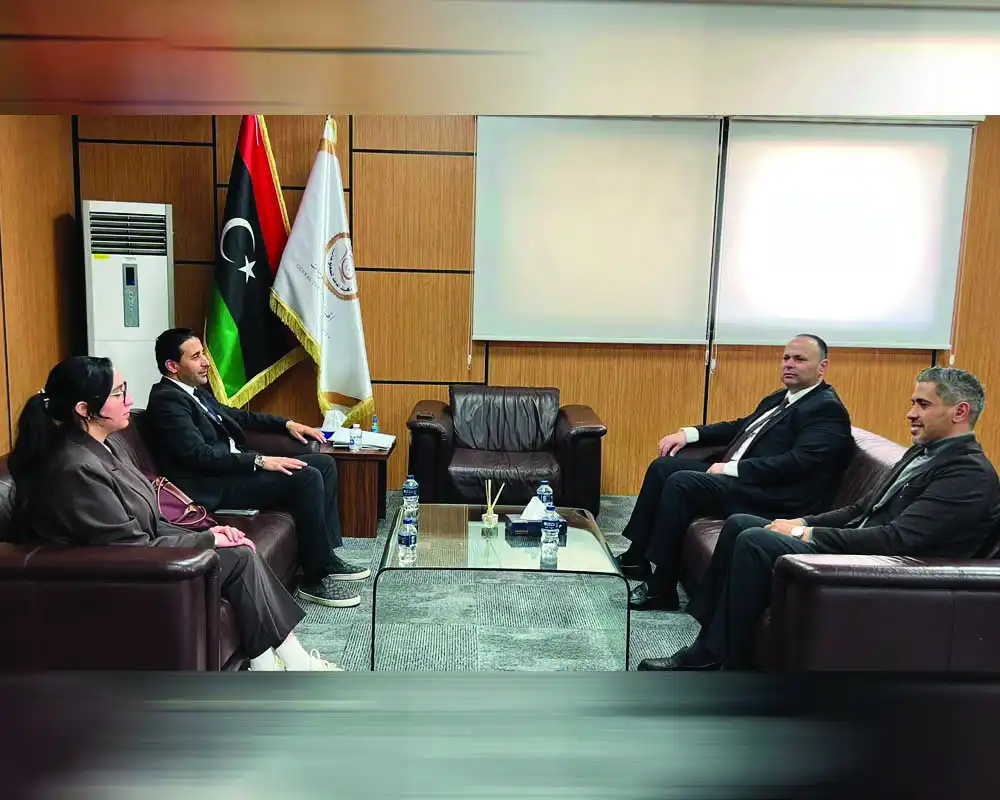
As part of strengthening institutional integration and supporting the digital transformation path in the Libyan state, the Chairman of the General Information Authority, Abdelbaset Al-Baour, met with the Minister of State for Digital Economy and Artificial Intelligence, Ziad Al-Hajjaji. During the meeting, ways to integrate artificial intelligence technologies according to national requirements and to enhance their role in supporting the national economy were discussed.
During the meeting, the Chairman reviewed the national efforts that have been implemented over the past years in the field of artificial intelligence, which were carried out in coordination with the General Authority for Communications and Informatics, within a national path initiated in 2023, aiming to establish the necessary institutional, regulatory, and legislative frameworks to build a responsible and effective national AI system.
The key national outputs in this area were also reviewed, which included the preparation and adoption of a number of reference documents, including the National Artificial Intelligence Policy, the National Charter for AI Ethics, and the National Artificial Intelligence Strategy (2025–2030), in addition to Libya’s active participation in the preparation of the Arab Artificial Intelligence Strategy and its adoption within the activities of the Arab Ministers Council of Communications.
During the meeting, the National Digital Government Framework, which is planned to be launched in the near future and represents the national reference for building the state’s public digital infrastructure (LY-eGov), was reviewed. In addition, the National Data Governance Policy, the National Data Exchange (LY-NDEX), and the National Digital Identity Project (LY-DNID) were reviewed, as they are essential digital enablers representing the transformation point from the traditional digitization phase to the integrated sovereign digital state model.
For his part, Minister of State for Digital Economy and Artificial Intelligence Affairs Ziyad Al-Hajajji affirmed his appreciation for the national efforts made to reach this stage, pointing out that the next phase will focus on capacity building and adopting modern technologies, which will contribute to enhancing the impact of artificial intelligence on the national economy, supporting the establishment of an effective digital economy ecosystem, in addition to empowering youth and entrepreneurs and creating an environment supportive of innovation and entrepreneurship.
Both parties confirmed the importance of moving to the implementation phase of the National Artificial Intelligence Strategy, through preparing executive frameworks and operational plans, identifying national priority projects, and developing performance measurement indicators to ensure achieving the targeted economic and developmental impact.
The pivotal role that the Ministry of State for Digital Economy and Artificial Intelligence Affairs can play as a coordinating and supportive umbrella was also emphasized, contributing to aligning economic policies with the requirements of adopting artificial intelligence technologies, and enhancing its contribution to supporting economic development and digital transformation.
At the conclusion of the meeting, the Chairman of the Authority confirmed the readiness of the General Information Authority, in coordination with the General Authority for Communications and Informatics, to fully cooperate and provide technical support to complete the preparation of the relevant executive frameworks and national plans, thereby strengthening the establishment of an integrated national system for the governance and adoption of artificial intelligence technologies in Libya.