• Tripoli | Wednesday, July 8, 2026
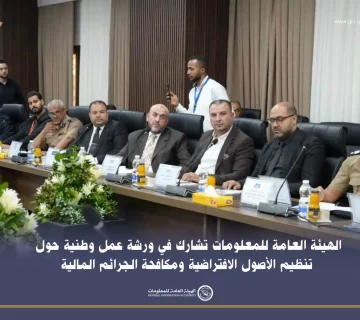
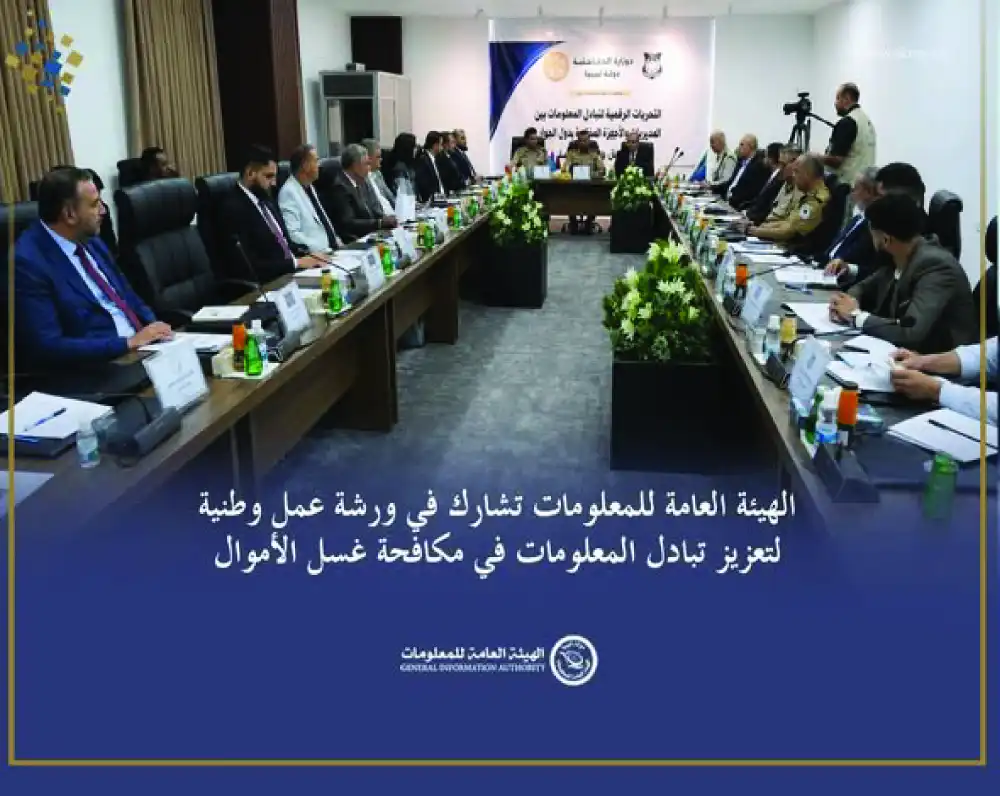
The General Information Authority (GIA) participated in a specialized workshop focused on discussing the procedural challenges of information exchange among national institutions within the framework of combating money laundering and terrorism financing. Organized by the Ministry of Interior, the workshop concluded its sessions today, Wednesday, July 8, 2026, in the presence of Major General Abdulwahid Abdulsamad, Director of the Office of the Minister of Interior, alongside several ministry leaders and officers.
The workshop brought together representatives from the Prime Minister’s Office, the Central Bank of Libya, the Libyan Financial Intelligence Unit, the General Information Authority, the Tax Authority, the Customs Authority, the Civil Status Authority, the General Union of Chambers of Commerce, Industry, and Agriculture, the Libya Trade Network, the Commercial Registry Authority, and the National Authority for Information Security and Safety. This diverse gathering aims to strengthen institutional coordination and integrate roles among the national entities responsible for combating money laundering and terrorism financing.
The Authority was represented at the workshop by Mr. Nader Melitan, Director of the Database Management Department, who participated in technical panel discussions aimed at developing information exchange mechanisms and enhancing institutional integration among relevant parties.
The scientific and practical sessions addressed the most prominent challenges facing information sharing among national institutions, exploring ways to resolve them by improving coordination and integration mechanisms to boost the efficiency of the anti-money laundering and counter-terrorism financing system.
The participation of the General Information Authority stems from its strategic role in providing the national digital infrastructure and developing data exchange and digital verification systems. The Authority’s national projects—most notably the Libyan National Data Exchange (LY-NDEX) and the Libyan Digital National Identity (LY-DNID) system—serve as a fundamental pillar for strengthening integration across government bodies. These projects enable secure and reliable information exchange, directly supporting financial compliance requirements and anti-money laundering and counter-terrorism financing efforts.
The workshop concluded with a series of recommendations emphasizing the importance of upgrading cooperation and information-sharing mechanisms between competent authorities. It also highlighted the need to maximize the benefit of the national digital infrastructure to help protect the national economy, raise the efficiency of the compliance system, and uphold the rule of law.