Benghazi | Monday, May 11, 2026
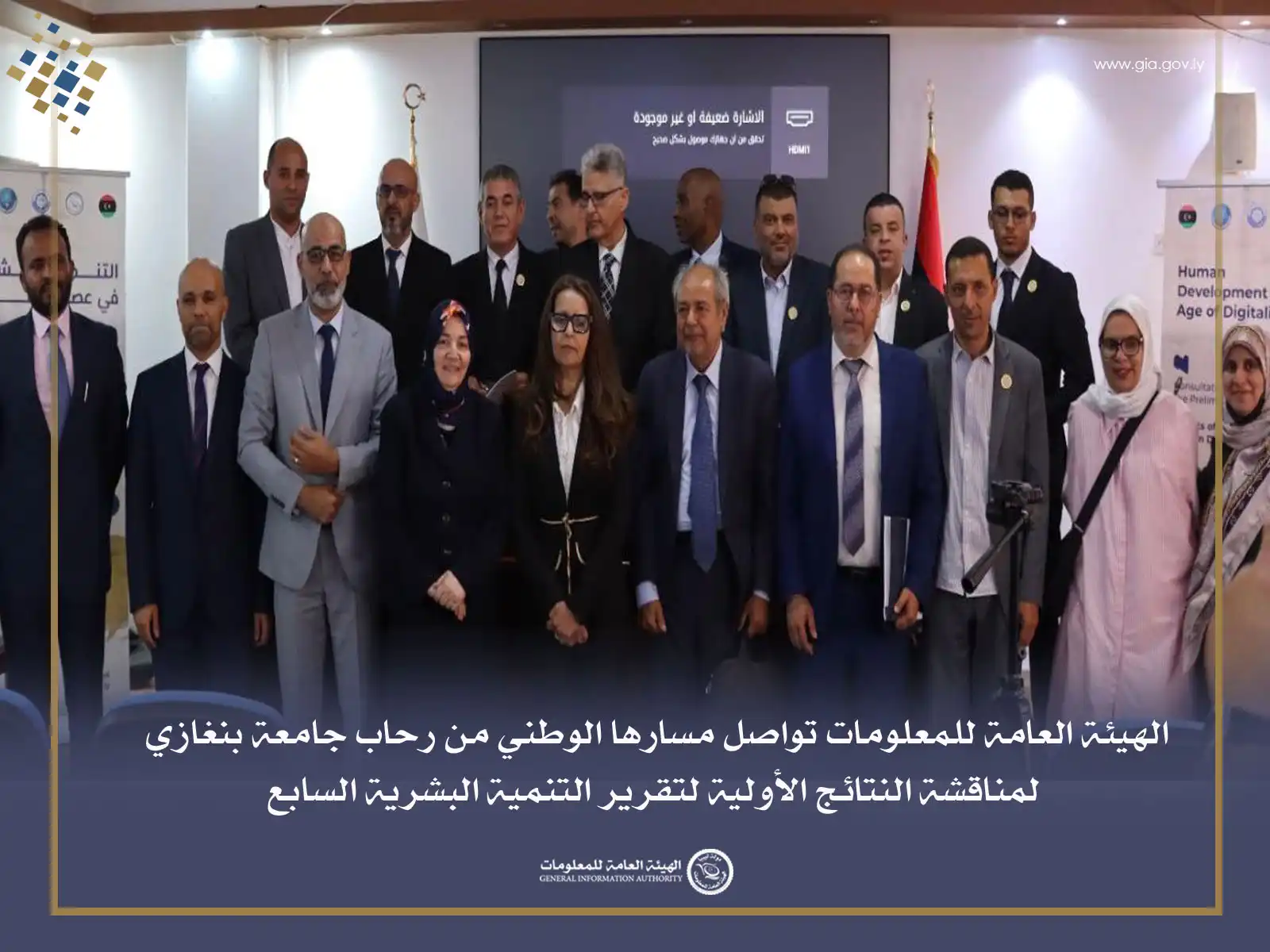
In a strategic step reflecting a commitment to the principle of community participation in national policymaking, the General Information Authority (GIA) organized today, Monday, the fourth expanded community consultation session. This session was dedicated to reviewing the preliminary results of the Seventh National Human Development Report, held at the prestigious University of Benghazi, in strategic partnership with the United Nations Development Programme (UNDP).
The session, hosted at the University’s Research and Consultation Center, opened with a series of speeches outlining the partnership between academic, technical, and international institutions. The university representative welcomed the attendees, emphasizing that hosting this event stems from the university’s role as a national house of expertise. He explained that universities are the scientific guarantee for the integrity of developmental outcomes, stressing that human development is the fundamental engine for any true renaissance, and that the University of Benghazi places all its research centers and academic minds at the service of this sovereign national project.
For his part, the GIA representative emphasized in his speech that this meeting embodies the Authority’s vision of providing information. He noted that the seventh report is based on building a robust national database that transcends traditional patterns. He added: “We are here today to present our findings of figures and indicators for academic critique, believing that correct developmental decisions can only be built on accurate and transparent scientific evidence.”
The representative of the United Nations Development Programme (UNDP) praised the professional level at which these national consultations are conducted. He emphasized that the cooperation with the General Information Authority and Libyan universities represents a model to be followed in drafting international reports with local visions, ultimately aiming to achieve a balance between economic growth and social welfare.
The session then moved to the technical presentation phase. Dr. Mohammed Al-Hamali provided a comprehensive overview of the methodological perspective on which the report was built, reviewing sample selection criteria, indicator measurement tools, and how global human development standards are aligned with the demographic and geographical specificities of the Libyan state to ensure a neutral and objective report. In turn, Dr. Adel Mohammed Al-Sharkasi, a member of the report’s editorial board, reviewed the preliminary results of the surveys and field studies. The technical presentations concluded with an “ADS” presentation by Professor Dr. Saqr Hamad Al-Jeibani, focusing on the economic dimension of human development. During his presentation, Al-Jeibani analyzed the direct correlation between improving the quality of human capital and increasing economic growth rates.
The session concluded with an open discussion characterized by transparency and depth. Academics and researchers in Benghazi provided several technical notes and recommendations to enrich the report in its final version.
This station is part of a series of tours led by the General Information Authority across various Libyan regions, in partnership with the UNDP and in close cooperation with Libyan academic institutions. This confirms that the Seventh National Human Development Report is a national document drafted by Libyans for the future of Libya, intended to serve as a historical reference and a practical guide for rebuilding the state on foundations of knowledge and accurate data.